If you are planning a new website, the first question is usually the hardest one to get a straight answer to: how much is it going to cost?
The honest answer is that it depends on what the website needs to do. But that does not mean you have to go in blind. In this guide we break down what UK businesses typically pay in 2026, what you are actually paying for, the ongoing costs that often get forgotten, and how to tell whether a quote is fair.
The short answer
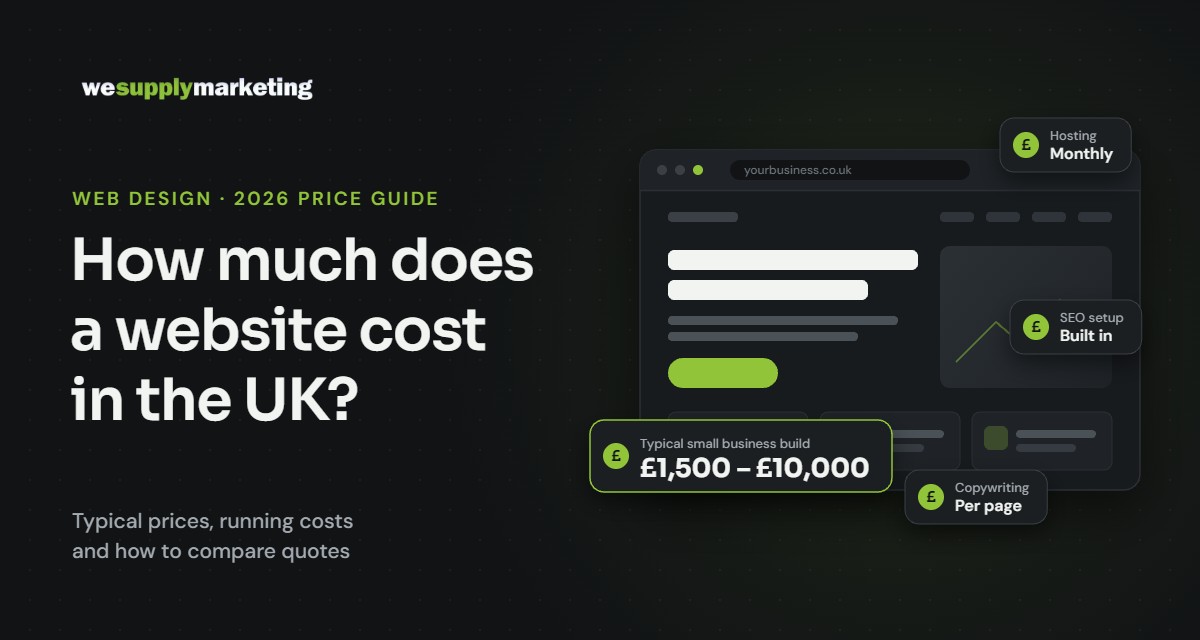
Most UK small businesses pay between £1,500 and £10,000 for a professionally built website, plus around £500 to £2,500 a year to host, maintain and keep it secure. A simple site from a freelancer can cost less; an online shop or a bespoke build can cost a lot more.
| Option | Typical upfront cost | Typical ongoing cost |
|---|---|---|
| DIY website builder (Wix, Squarespace and similar) | Your time | £10 to £40 a month for the plan |
| Freelance web designer, 5 to 10 pages | £500 to £3,000 | £20 to £100 a month |
| Agency-built business website | £2,500 to £10,000 | £30 to £150 a month |
| E-commerce website | £5,000 to £15,000+ | £50 to £300 a month |
| Bespoke or complex build | £15,000+ | Agreed per project |
Typical UK market ranges in 2026, excluding VAT. London agencies tend to sit at the top of these ranges or above them.
What you are actually paying for
A website quote is not just the cost of “making some pages”. A properly built business website usually includes:
- Planning and structure: working out which pages you need, what each one is for and how visitors move through the site to get in touch.
- Design: layouts for desktop, tablet and mobile that fit your brand, rather than a template with your logo dropped in.
- Copywriting: clear, persuasive words for each page. This is often the biggest hidden job in any website project.
- Build and development: turning the design into a working site, including forms, maps, booking tools or anything else it needs to do.
- SEO foundations: page titles, descriptions, headings, site speed, structured data and a sitemap, so Google can find and understand the site from day one.
- Testing and launch: checking every page on different devices and browsers, setting up redirects from any old pages, and connecting analytics.
- Training: showing you how to make your own updates, so you are not paying every time you want to change a sentence.
When two quotes look very different, it is usually because one includes most of this list and the other includes very little of it.
What makes a website cost more, or less
Number of pages and page types
A five-page brochure site costs less than a 40-page site with service pages, location pages and a blog. What matters most is how many different page layouts need designing, rather than the raw number of pages.
Custom design or template
A template keeps costs down but makes it harder to stand out. A custom design takes longer, but it is built around your business, your customers and what you want them to do.
Content and copywriting
If you supply finished words and images, the project is quicker. If the agency writes the copy, plans the messaging and sources imagery or video, expect that to be reflected in the price. It is usually money well spent, because the words are what persuade people to get in touch.
Features and integrations
Online booking, payments, membership areas, CRM integrations, quote calculators and product catalogues all add time. An online shop adds product setup, payment gateways, delivery rules and testing on top.
Replacing an existing website
If you already rank on Google, a new site needs a careful migration: mapping every old URL to its new home with redirects, keeping what already works and fixing what does not. Skipping this step is one of the most common reasons businesses lose traffic after a redesign.
Who builds it
Day rates vary between DIY, freelancers and agencies, but so does what is included. That is worth a closer look.
DIY, freelancer or agency: which is right for you?
DIY website builders
Platforms such as Wix and Squarespace are the cheapest way to get online, and they can work well for a new business testing an idea. The catch is your time, and the fact that design, copy and SEO are all down to you. Moving away from a builder later usually means starting again.
Freelance web designers
A good freelancer can deliver a solid small website at a sensible price, and you often deal with the person doing the work. The trade-off is capacity: copywriting, SEO and ongoing support may not be included, and you are relying on one person being available when something needs fixing.
Digital marketing agencies
An agency costs more upfront, but you get a team: strategy, design, copy, development and SEO under one roof, plus support after launch. The real value is when the website is planned alongside the rest of your marketing, so your Google Ads, SEO and social media all point people to pages built to convert them.
As a rough guide: if the website is a nice-to-have, DIY or a freelancer may be enough. If it is how most of your customers find and judge you, it is worth investing in properly.
The ongoing costs people forget
The build is a one-off cost, but every website has running costs too. Budget for:
- Domain name: around £10 to £20 a year for a .co.uk or .com.
- Hosting: anything from under £10 to £50 a month. Cheap shared hosting is often the reason a website feels slow.
- Maintenance and security: keeping WordPress, themes and plugins updated, backed up and monitored, typically £30 to £150 a month depending on what is included.
- Licences: some premium themes, page builders and plugins carry annual fees.
- Content and improvements: new pages, blog posts, photography and design tweaks as your business changes.
- Getting traffic: a website does not market itself. SEO, Google Ads, email and social media are what bring the visitors in.
For a typical small business website, the running costs come to roughly £500 to £2,500 a year before any marketing spend.
When a cheap website ends up expensive
A low quote is not automatically a bad one, but these are the warning signs we see most often when businesses come to us after a website that has not worked out:
- You do not own it. The site, domain or hosting is in the designer’s name, or built on a system you cannot take elsewhere.
- It is slow. Heavy templates and budget hosting lead to slow pages, and slow pages lose both visitors and rankings.
- Google cannot make sense of it. Missing page titles, no structured headings and no sitemap mean it struggles to rank for anything.
- Nobody planned the move. An old site is switched off without redirects, and years of rankings disappear overnight.
- It looks good but does not convert. No clear calls to action, forms that do not work properly on mobile, or nothing that explains why someone should choose you.
Fixing these problems later often costs more than doing the job properly in the first place.
Questions to ask before you choose
To compare quotes fairly, ask every supplier the same questions:
- What exactly is included: design, copywriting, SEO setup, testing, training?
- Will I own the website, the domain and the hosting account?
- Will I be able to edit the content myself, and how?
- How will you protect my existing Google rankings if I am replacing a site?
- What does hosting and support cost after launch, and what does it cover?
- How long will the project take, and what do you need from me?
- Can I see examples of similar websites you have built, and the results they got?
A good supplier will be happy to answer all of these in plain English.
Is a website worth the investment?
A better way to think about cost is return. If a new website brings in even a handful of extra enquiries each month, and each new customer is worth hundreds or thousands of pounds to your business, a well-built site pays for itself quickly. A cheap site that nobody finds, or that does not persuade people to get in touch, is expensive at any price.
How we approach website projects
At We Supply Marketing we build fast, custom WordPress websites for businesses across Preston, Lancashire and the rest of the UK. Every site is planned around one thing: turning visitors into enquiries. SEO is built in from the start, and sites are built so you can edit your own content without calling us every time.
Because every business needs something different, we quote each project on its scope rather than a one-size-fits-all package. You can find out more about our web design and development service, or see how it fits with SEO and the rest of your marketing.
Already have a website and not sure whether it needs replacing or just improving? Start with a free website health check. We will look at its speed, Google visibility and how well it turns visitors into enquiries, and tell you honestly what is worth fixing first.
Frequently asked questions
How much does a 5-page website cost in the UK?
A simple five-page website from a freelancer typically costs £500 to £1,500. From an agency, expect roughly £2,500 to £5,000, depending on how much design, copywriting and SEO is included.
How much does it cost to run a website each year?
For most small business websites, hosting, domain, maintenance and security come to roughly £500 to £2,500 a year. E-commerce sites and larger websites cost more to run.
Is WordPress cheaper than Wix or Squarespace?
WordPress software is free, but you pay for hosting, design and maintenance. Website builders have lower upfront costs but ongoing monthly fees and less flexibility. Over a few years, a well-built WordPress site often works out better value for a growing business, because you own it and it can grow with you.
How long does it take to build a website?
A small business website usually takes four to eight weeks from kick-off to launch. Larger sites, online shops and projects with lots of new content can take three months or more. Getting content and feedback back quickly is the biggest factor you control.
Will I own my website if an agency builds it?
You should. Make sure the domain, hosting account and website files are in your name, or that the contract confirms you own them. It is one of the most important questions to ask before you sign.
Will a new website affect my Google rankings?
It can, either way. A well-planned redesign with proper redirects and SEO foundations often improves rankings. A rushed launch without redirects can lose traffic you have spent years building, so make sure your supplier has a clear plan for it.